

How greedy microtransactions sparked EVE Online's disastrous Summer of Rage | PC Gamer - mayfielddisce1964
How greedy microtransactions sparked Eve Online's disastrous Summer of Rage
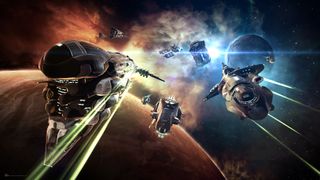
Conflict is etched into the very gist of EVE Online. Connected any given daytime, thousands of players war against one another as its player-run alliances clash over key star systems and resources. But one of EVE Online's most disastrous conflicts happened in 2011, when a serial publication of bad development decisions led to in-game protests of an new scale that, to this day, remain a bitter memory for Evening Online's long-time pilots. Those a couple of destructive months became known as Eventide Online's Summer of Fad.
Empires of Even: Volume 2
You can find out more information about Empires of EVE: Volume 2 on its official website.
St. Andrew Groen is an Evening Online historian who has turned its continuous conflicts and bitter betrayals into a series of books that chart Evening Online's lurid in-game history. The first book, Empires of EVE, explored EVE Online's early conflicts from its launch in 2003 direct to the conclusion of The Great War, which cemented player-run alliances similar Goonswarm has one of New Eden's foremost superpowers. In Empires of Eventide: Volume 2, which released on May 25, Groen retells the biggest stories of EVE Online's modern era.
In that exclusive transcript taken from the midway of Volume 2, Groen recounts the giant missteps by CCP Games that LED to widespread in-game protests in the summer of 2011, the ripples of which are shut up felt in EVE to this day.
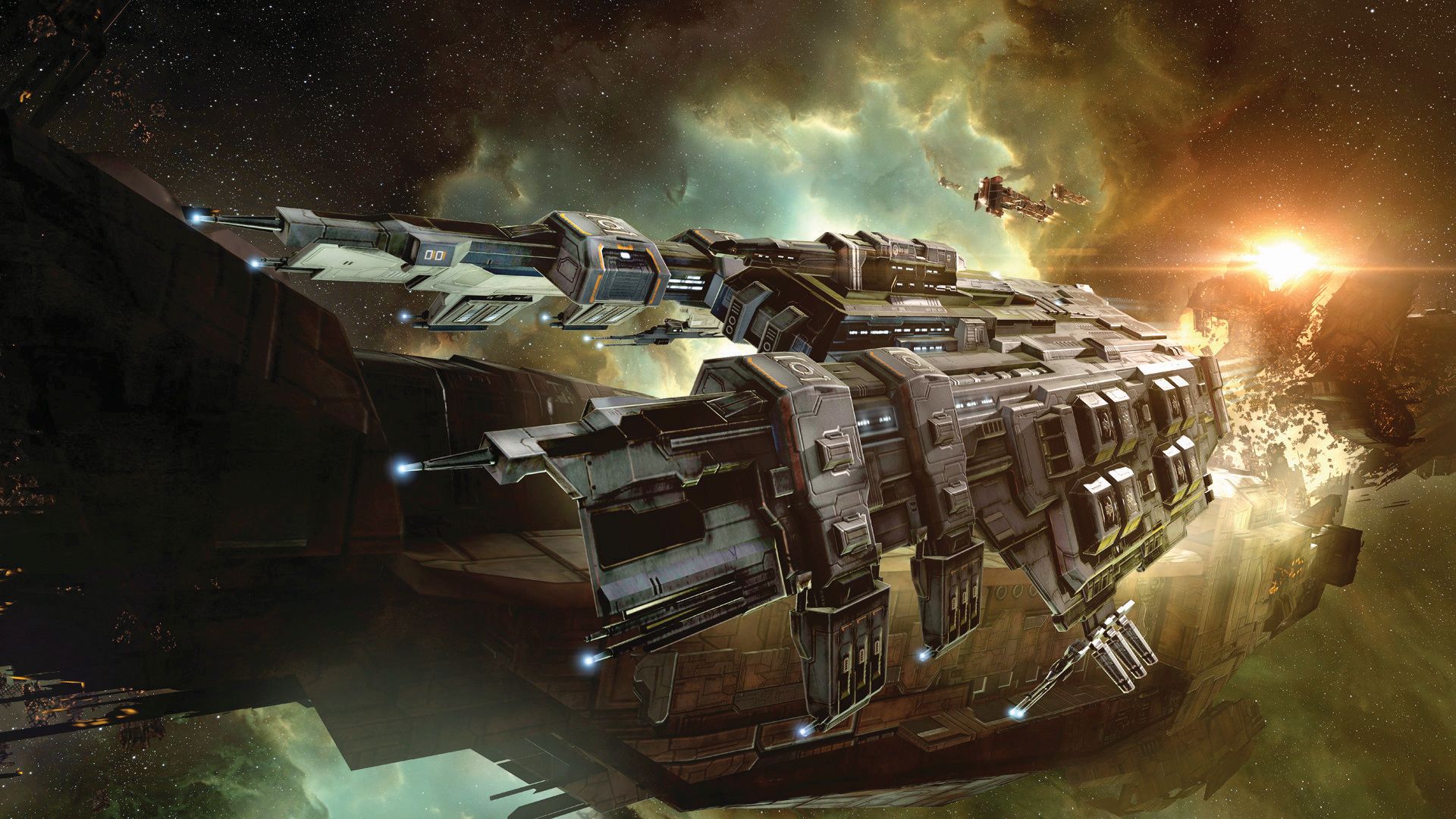
The Summer of Rage
In 2011, EVE Online was reaching the prime of a quiet ascension. The count of players signed and attached in the community had been growing steadily since 2003, but that pace had quickened dramatically in 2005 and kept up at a brisk pace of growth through to 2010, when the persistent climb up finally began to reach a high tableland. EVE Online made global news atomic number 3 its population grew past that of Iceland, its mother nation.
The independent metric the biotic community uses to gauge the health of the game is named "Common Concurrent Users" which is the average of how galore accounts are logged-in to EVE Online at any precondition time throughout a calendar month. In January 2011, EVE reached its highest ever ACU—roughly 60,000 people online in New Eden at any relinquished time—and the company was in the midst of a solemnisation of its vision for EVE.
The main player hub in Evening for that massive concentration of players was the trading hub "Jita" OR more specifically, the "Caldari Navy Assembly Plant life" orbiting the fourth Sun Myung Moon of Jita's fourth planet.
Whether its haters like it Oregon non, under Jita's wrist is the heart rate of Virgin Eden.
Andrew Groen
Jita is the most famous system in EVE Online, and has been fundamentally since the stake's founding. Jita is a place unlike any other in EVE. Information technology was organically elect by the players to get over the commercialize hub of Eventide Online due entirely to its natural geography, family to a space platform owned by ane of the game's NPC factions where players throne buy and betray goods.
Maybe appropriately, Jita is also perfectly reviled, even by EVE's own players. IT's the center of New Eden's diligence and commerce, and it's unremarkably the most thickly settled principal system. Many—if not nigh—of New Eden's 7500 star systems are often nearly empty, but Jita's position as the player market hub means it is routinely full with thousands of players. Precisely because of that, it's also absolutely rife with scammers and bots. Wholly of that traffic, scheming, and harassment makes it into a lay that is bustling, thriving, collusive, and singularly despised. Put differently, zero other identify is quite soh quintessentially Eventide. Whether its haters like IT or non, low Jita's wrist is the pulse rate of New Eden.
EVE Online was no longer the plucky Icelandic social experiment from 2003. Now information technology was unrivalled of the biggest products in the video game industry, with more than 500,000 subscribers bringing in millions of dollars per month for a growing online gaming troupe with round ambitions.
CCP Games' ambition to create a virtual space that survived for decades was opening to appear downright practical, and Jita was its capital. The company even began victimisation the word "EVE Forever" as a tagline in advertisements, a nod to the for the most part-serious theme that EVE could become the first realistic space to achieve true permanency and never be shut down.
As EVE Online grew and grew, the player community was combined in solemnisation with CCP. The relationship 'tween CCP and the community had been severely damaged by the "T20 outrage" of 2007 in which a developer (who went by the key "T20") was found to comprise cheating. Simply as time rolled connected and the game continued to grow up, the 2 sides remembered that their Three Weird Sisters were connected, and the players once again began to see success for CCP as success for EVE.
However, as we will see therein chapter, business decisions made in Reykjavik, Republic of Iceland soon spurred mass protests in the Jita genius system within Eve Online. IT all began with a single word that launched a volume biotic community revolt:
"Covetousness is good?"
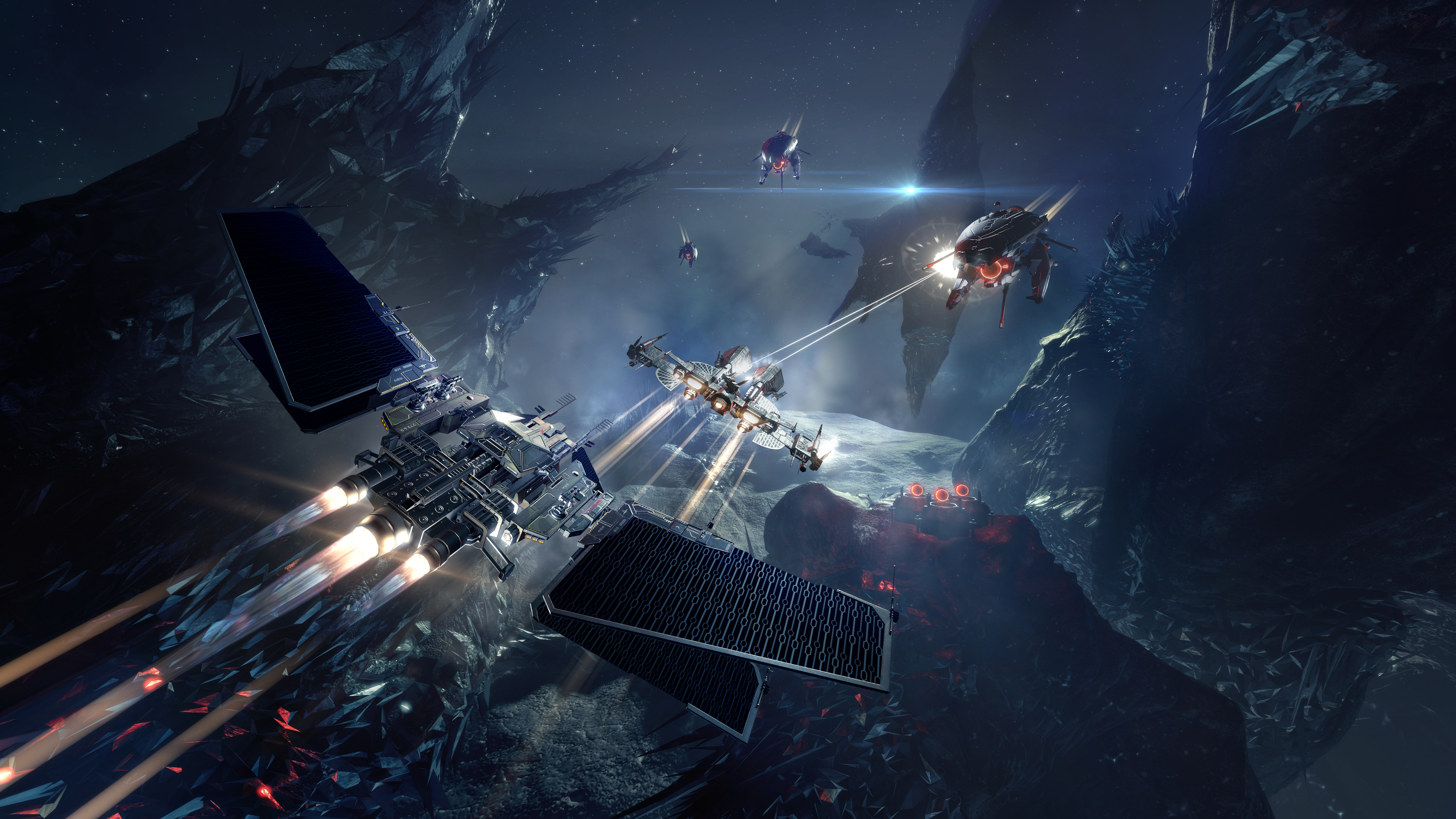
Ambitiousness
Eastern Samoa EVE's player base expanded, so did the developers' vision for the game.
Iceland—the home body politic of CCP Games—was, in the late 2000s, ill from literally the worst banking crash in the history of economics. To make matters worse, in early 2010, the tiny island's volcano Eyjafjallajokull (pron: eya-fyatla-yoktl) erupted, shouting 750 tons of magma per second into the sky, blanketing the country and half the chaste of Europe in ash, and disrupting economies and air go out systems.
When CCP Games looked inside its servers it saw a virtual world that was somehow more financially stable, less mountain, and if you could conceive it, more populous than Iceland.
Not only was Even Online becoming one of the near enviable products in the gaming industry, with the most unique player experiences; from the perspective of CCP, EVE looked like the future of humanity itself. Straight-grained as the world literally melted down or so them, CCP Games presided over eight years of year-over-year growth for EVE.
The core of the company was a group of people whose most outlandish and optimistic melodic theme of the late-90s (EVE Online) had not only succeeded but had become a roaring global success worth hundreds of millions of dollars. What do you dream of when you're already living in your woolgather macrocosm? As EVE's player pedestal dilated, soh did the developers' vision for the game.
In the late 2000s, CCP dreamed of edifice not only if an entire suite of films and television shows supported the player stories you'Re reading in that book, but also an entire ecosystem of Evening-based games that coupled together into a one-woman virtual multiverse. One daytime, CCP hoped, players would be able to grab a joystick and vaporize as a fighter aircraft pilot in a first-person starship simulation (Evening: Valkyrie) in battles led by fleet commanders performin EVE Online, and then dock their ships in their newly conquered blank space station, meet for each one other at a bar as their avatars and then streak down from orbit to the surface of a planet to a first-soul shooter battle happening along the ground (Sprinkle 514) to fight for control of a defense platform which would actually affect some other battle somewhere in EVE. CCP unreal a future in which EVE organizations were sending coin forces into other video recording games to better control the ebb and menstruate of power in Eventide Online.
It was a hardihood and expensive imagination, and even with EVE Online bringing in tens of millions of dollars per twelvemonth CCP needed to find opportunities to make more money by bringing new services to the players.
The other curve occurring at this time that heavily affects this story is the accretionary preponderance of the sales agreement of essential goods in online games. Prior to ~2010, the vast majority of online video games used one of two business models: 1) the subscription model, which effervescent users a time unit fee for continued access to the game, and 2) the pay-up-front mold which gave users free entree to the servers once they'd paid the initial purchase toll. EVE victimized some. However, around this time various touristy games began to support themselves through and through the cut-rate sale of virtual items like incarnation clothing and consumable buffs.
Gambling communities—where vicious arguments over game balance are basically constant—disquieted that greedy corporations wanted to sell gameplay advantages to rich players. In the whip cases, it was obvious that certain companies had utilized gameplay excogitation itself as a subtle psychological claw to hold on players paying up.

Internal CCP Games, a argument arose near how this new model power interact with EVE. Like-minded a lot of large companies, CCP published a company-wide newsletter to help keep the company's employees on the same page. Called "Fearless," this newsletter was a weapons platform for company debates and perfervid op-eds advocating for changes in strategy. In the May 2011 issue, Fearless featured a striking, ruby cover page adorned with nothing but the simulacrum of extremist-capitalist villain Gordan Gekko propped up against his signature 80's leather power chair. Above his oral sex read the bolded words "Greed is Good?"
The theme of the issue was the monetization of essential goods, and the Letter from the Editor kicked slay the discourse:
"As EVE edges closer to being the grand dame of gaming, turn 8 years old this month, and our otherwise titles continue their prodigious growth our developing roadmap is shaping up stronger and better," reads the May 2011 emergence of Fearless.
"However," the editorial continues, "A a subscription-based Propitious Goose, EVE needs to incorporate the virtual goods sales model to allow for further revenue—revenue to fund our other titles, revenue for its developer: you."
What was being proposed was that EVE Online should suit one of the only when games in the world to use all leash major online play business models at the same time. Not only did EVE Online cost money to download, it too cost a $15 monthly tip, and the company now craved to introduce a new serial publication of cosmetic character items that were gated behind a paywall.
All eyes focused on the impending release of the next EVE Online expansion which was the dissertation statement for CCP's vision for the future of Even: "Incarna," from the Latin for "flesh."
World of Darkness
The Incarna expansion was to comprise the fulfillment of a longstanding dream of CCP Games. Because EVE Online is famously difficult for new players to grasp, the company had long sought to make EVE Online more accessible and perceivable to the average person. 1 of the big problems, they believed, was that average gamers don't want to play American Samoa a spaceship. CCP believed they sought-after to play as an avatar who pilots a spaceship. It was a subtle linguistics dispute with enormous aim and production implications.
Their solution and vision for the prox of EVE Online was the "walking in stations" feature film. Previously, EVE players' avatars were little more than a fine picture in the corner of their user interface. With Incarna, CCP spoke of a dream for Even in which players could bobtail their ships and perambulate a personal space called their Captain's Living quarters, or even "ambulate" around John Roy Major stations like Jita 4-4 and encounter other players at shops, bars, and encounter places. In the nigh widespread visions, it might even Be manageable for players and mercenaries to assassinate one another in these public spaces.
"Although EVE Online was CCP's flagship product, the company was also in growing of an incarnation-settled vampire MMO legendary atomic number 3 World of Darkness, also as a ground-based get-go-person torpedo known as DUST 514," wrote Eve journalist Matterall in a retrospective. "Rather than use an active game locomotive engine, CCP began to develop its own proprietary graphics locomotive engine known as Carbon to great power these incarnation-based games. Carbon would also be the engine used to develop EVE's prearranged expansion into avatar-based stake play."
The ontogeny of Incarna takes commit parallel to many of the events of this script, and had been unfolding for years already. It was first off announced all the way aft in 2007—four years preceding—and had become just another promised feature on the development backlog.
Many Eve players saw this as an open backstab, given that Even had always been a PC-only if experience.
Equally the expansion edged closer to release, CCP Games journeyed to the Electronic Entertainment Expo—at the meter the biggest event of the year in gaming—to divulge its multi-game vision for EVE, focalisation on the first common information close to its first-person shooter lame Junk 514.
However, there was a perplexing detail in their presentation that caught the Evening residential district wholly off-guard, and it would one of these days cascade into a filled-on public relations crisis that unnatural CCP Games to layoff one in basketball team employees:
CCP announced that Rubble 514 would be a console exclusive. Available merely on Sony's Playstation 3 chopine.
Meet B3yond
Many EVE players saw this as an open backstab, presumption that Even had always been a PC-only experience. They saw a nakedly ambitious move by CCP to try to draw millions of "cabinet gamers" into EVE Online. Many in the EVE biotic community were perplexed and angered to find that the gamy intended to expand their community's experience was in point of fact not playable by a large-mouthed portion of them who didn't have the console.
Thousands of EVE players voiced their displeased on the forums and early social media...all together. It happened so quickly that at first CCP didn't fully understand what it was dealings with: the opening stages of a full-on community of interests revolt. CCP thought these were run-of-the-mill meeting place controversies that would fly the coop out of gas in a couple of years.
If you look at the Medium Coinciding Users for EVE Online there is almost forever a boost in player activity after a new expansion debuts as players reactivate their accounts to experience all the new stuff with their friends. But after Incarna there was a net decrease as dashing hopes gripped the community immediately.
The expansion which had consumed years of Even Online development clock was a massive dashing hopes. Secure features were missing, and the ones that were included often came with ironic catches. When players docked their ships in a station they would now come along inside the base as an embodiment. Omit the space you could move approximately in was a static room of simply about 10x15 feet, and was smooth-skinned as a rusty Minmatar (one of the back's traditional knowledge races) station no matter where you were in quad. It also lagged badly, caused equipment failures in some players' machines, and inherently removed many EVE players' favorite interest: superficial at their ships in their hangar. Now, instead of looking at their beautiful ships they were cursed to the inside of a unstimulating, lonely, rusty metal prison cell inhabited only by an avatar they had never seen in front and thus had atomic number 102 bathetic connection to.
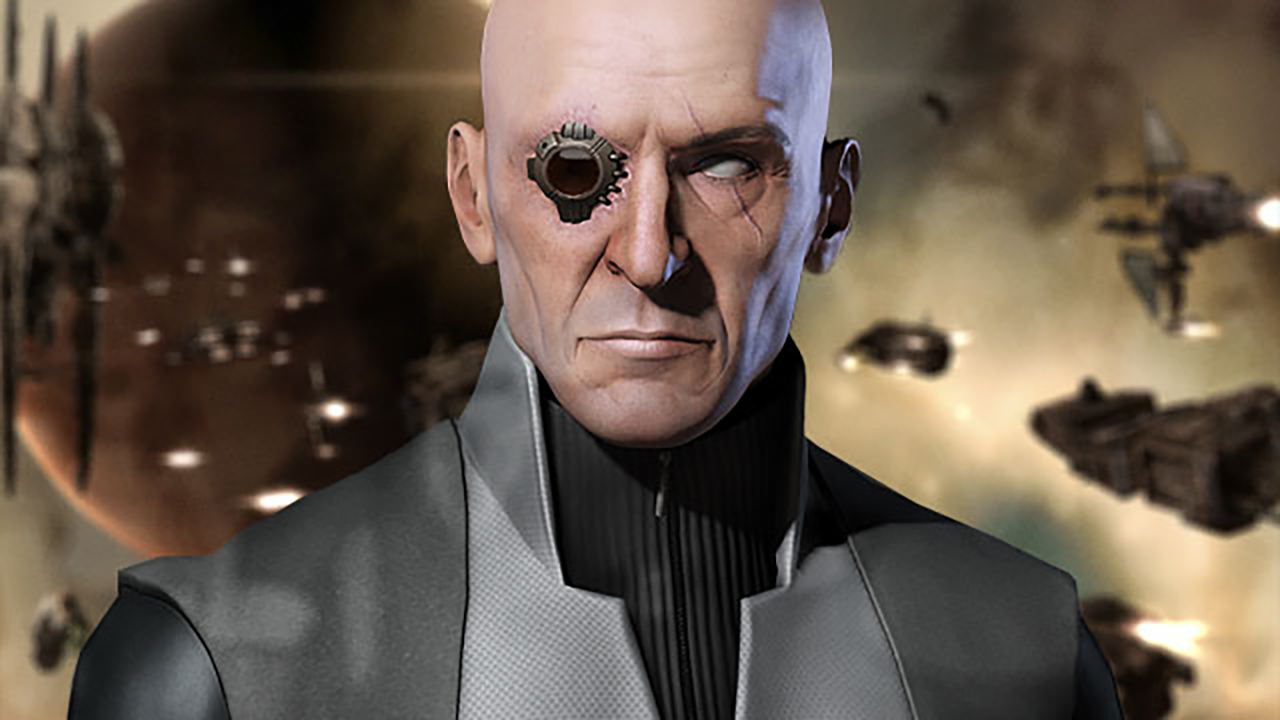
When players did the math they realized that the going rate for the eyepiece when translated to USD was an astounding $70.
Andrew Groen
The strange feature that had launched in the number one wave of Incarna was the Honourable Exchange or "NeX Store" which was essentially a digital shop for players to augment their new player avatar with vanity cosmetic items care jackets, boots, sunglasses, and a curious lowercase item that ended functioning making large waves: a metal monocle.
The information processing monocle could comprise purchased with a new in-game currency called "Aurum," but when players did the math they complete that the sledding grade for the eyepiece when translated to USD was an astounding $70. In contemporary world we know these are schoolbook conditions for an internet community revolt, but CCP was out front of its sentence, and did not yet have the benefit of history. The stage was set for what would become "Monoclegate."
"Information technology didn't take long for people to realise that something was fundamentally wrong with the prices on the Noble Commutation," wrote Brendon Drain for Massively.com, a publication that covers online role-playing games. "At around $40 for a canonical shirt, $25 for boots, and $70 or Sir Thomas More for the legendary eyeglass, items in the Titled Exchange were priced higher than their-real life-time counterparts."
"Given the fact that instrumentalist avatars could ambulate no farther than the Captain's Living quarters, these overpriced items looked like a cash grab by the company," wrote Matterall in a retrospective. "Gross, Incarna was a colossal disappointment after years of hype and mismanaged histrion expectations. The mood of the playerbase shifted rapidly from thwarting to outright disgust."
The followers day the controversy within the community reached an even more fevered pitch. On June 22, amid all the community of interests furor, person interior CCP Games leaked the May 2011 issue of Fearless on the backchannel forum Kugutsumen.com.
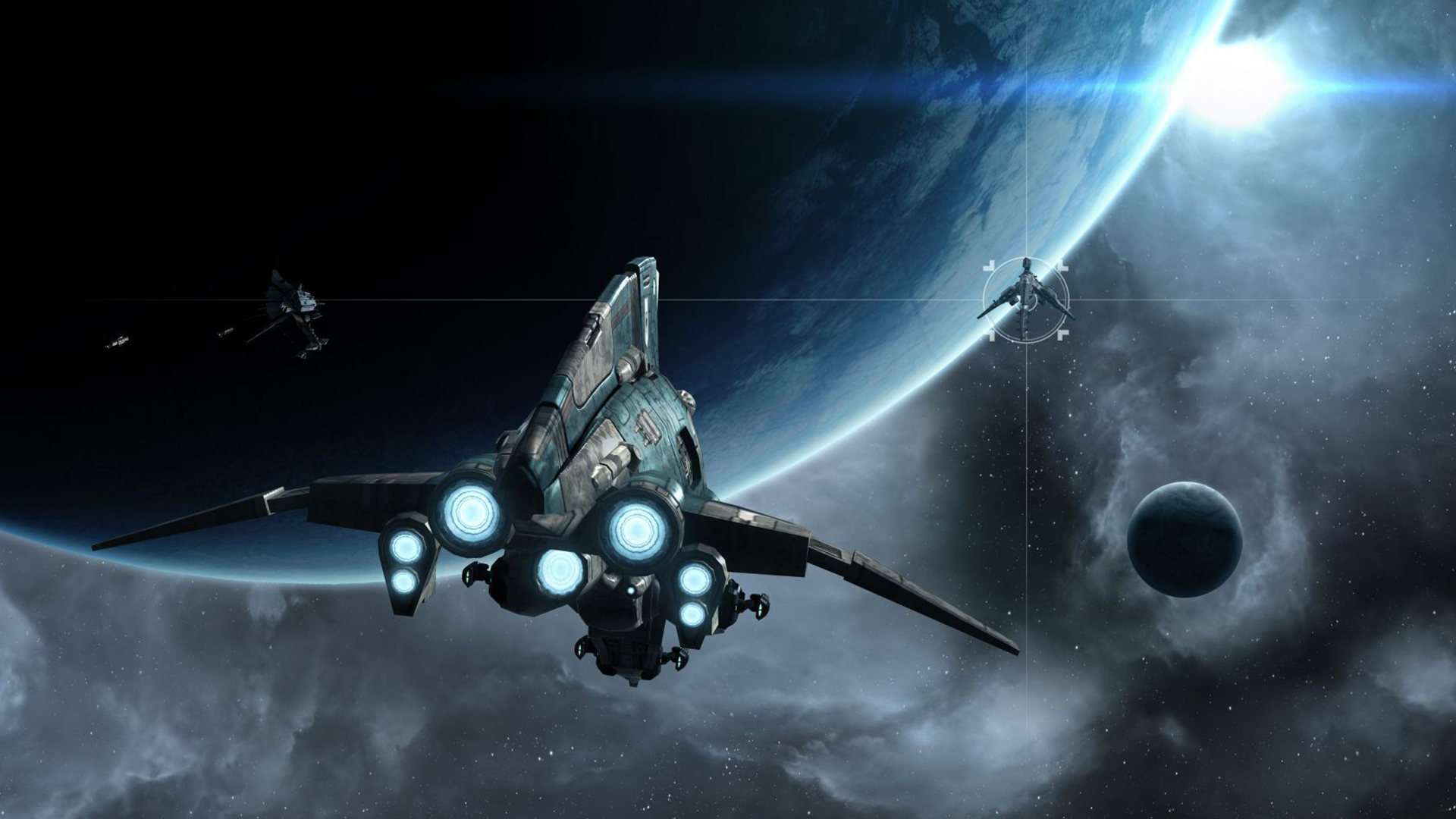
"The Day EVE Online Died"
The hardcore fan community exploded with fear and skepticism around the rising of EVE Online, with many leaping to the conclusion that this was a death ring for Even as CCP would inevitably sneak into the same shadowed business practices that had been seen in many another other contemporary games.
For the first time, the wider community was able to read on with CCP discussions, and gain an understanding of how the company viewed and discussed issues internally.
The players had gnomish context for the purpose of the corporate newssheet. CCPers read that its role was mainly to surrogate discussion within the troupe about key issues and at times wager daemon's advocate to research disputable points of view, the kind of thing Icelanders take pride in. However, the popular sensing abroad was that this was a glance into CCP's secret mind, a greed wart that it had hidden from the players for years and allowed to fester.
Developers tried to soothe fears, but ended up lonesome contributory to the everlasting disaster that was flowering. Senior Producer "CCP Zulu" wrote a developer blog to address player complaints.
"This week has seen quite an controversy blossom," Zulu wrote. "In almost the same instant as we deployed Incarna—which by the way is uncomparable of our more smooth and successful expansions, let alone absolutely beautiful—an internal newssheet with quite controversial topics addressed leaked out. To further compound the discombobulation there was a clear and rather large break in realistic goods pricing expected value and realness with a magnanimous segment of the community."
"While information technology's perfectly very well to disagree and attack CCP over policies or actions we take," Zulu continued, "we think back it's not cool how individuals that work here birth been called out and dragged through the mire due to something they wrote in the internal company newssheet. Severely, these people were doing their jobs and perform not deserve the hate and shitstorm being pointed at them."
Unfortunately, CCP Zulu's fiery supplication to spare the average employee of CCP Games fell on deaf ears as some players instead focused on comments he made in the blog which exacerbated the situation. In particular, the community was ruffled because CCP Zulu compared the $70 digital monocle to a pair of $1000 vanity jeans from a Japanese boutique.
The blog restricted with a disobedient statement that it was likely CCP would later introduce a variety of items for sale that were both Sir Thomas More affordable and more expensive than what was currently available.
To make matters much, much worse a recalcitrant all-fellowship email from CCP Games CEO Hilmar Veigar Pétursson was and so leaked online in which he urged employees to snub the outcry.
"transmitted by hilmar to ccp global list
We bouncy in interesting times; in fact CCP is the kind of company that if things get repetitious we instinctively crank it astir a nick. That, we certainly have done this week. First off we have Incarna, an amazing technological and artistic accomplishment. A vision from years past realized to a point that no cardinal could possess [notional] but a couple of months ago. It rolls out without a hitch, is in some cases faster than what we had before, this is the pinnacle of professional achievement.
For all the interference in the channel we should all stand proud, years from now this is what mass will recall.
But we have done more, not alone have we redefined the production quality one can apply to virtual worlds with the beautiful Incarna just we ingest also defined what it really means to do virtual reality more important than real world when it comes to entr our New virtual goods currency, Aurum.
Of course, we have caught the attention of the world. Only if a a few weeks past we revealed more information about DUST 514 and now we get done it again by committing to our core purpose as a company past redefining assumptions. After 40 hours we have already sold 52 monocles, generating Thomas More revenue than any of the other items in the store. [...]
Currently we are beholding _very predictable feedback_ happening what we are doing. Having the perspective of having finished this for a decade, I can tell you that this is one and only of the moments where we look at what our players do and less of what they say. Innovation takes time to set in and the predictable reaction is always to fend modify. [...]
All that same, I couldn't Be prouder of what we have accomplished as a company, changing the world is hard and we are doing it as indeed many times before! Stay the course, we have done this some times in front."
— Hilmar Veigar Pétursson, CEO, CCP
June 23, 2011
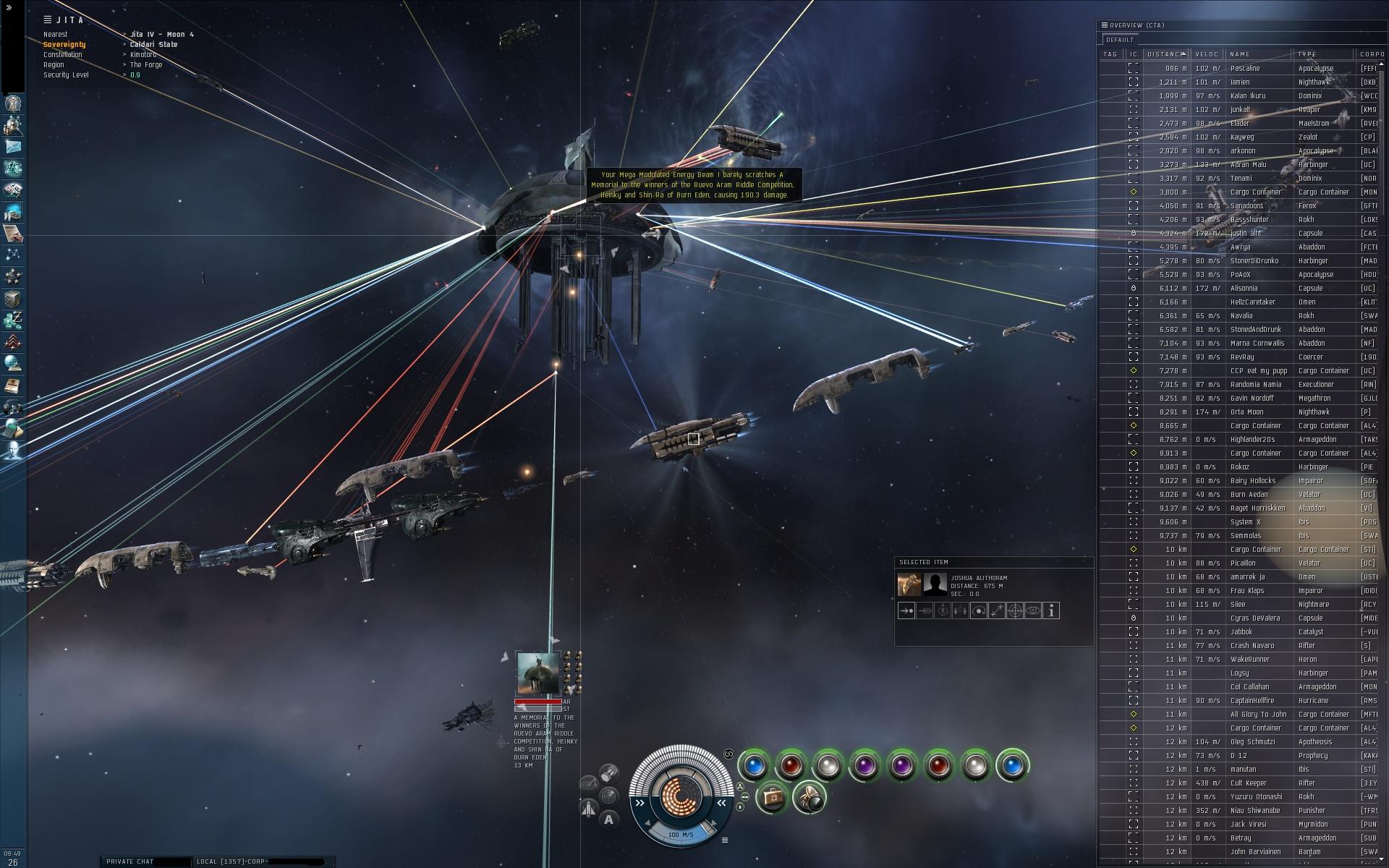
Thousands of players deactivated their alternate accounts in a show of protestation.
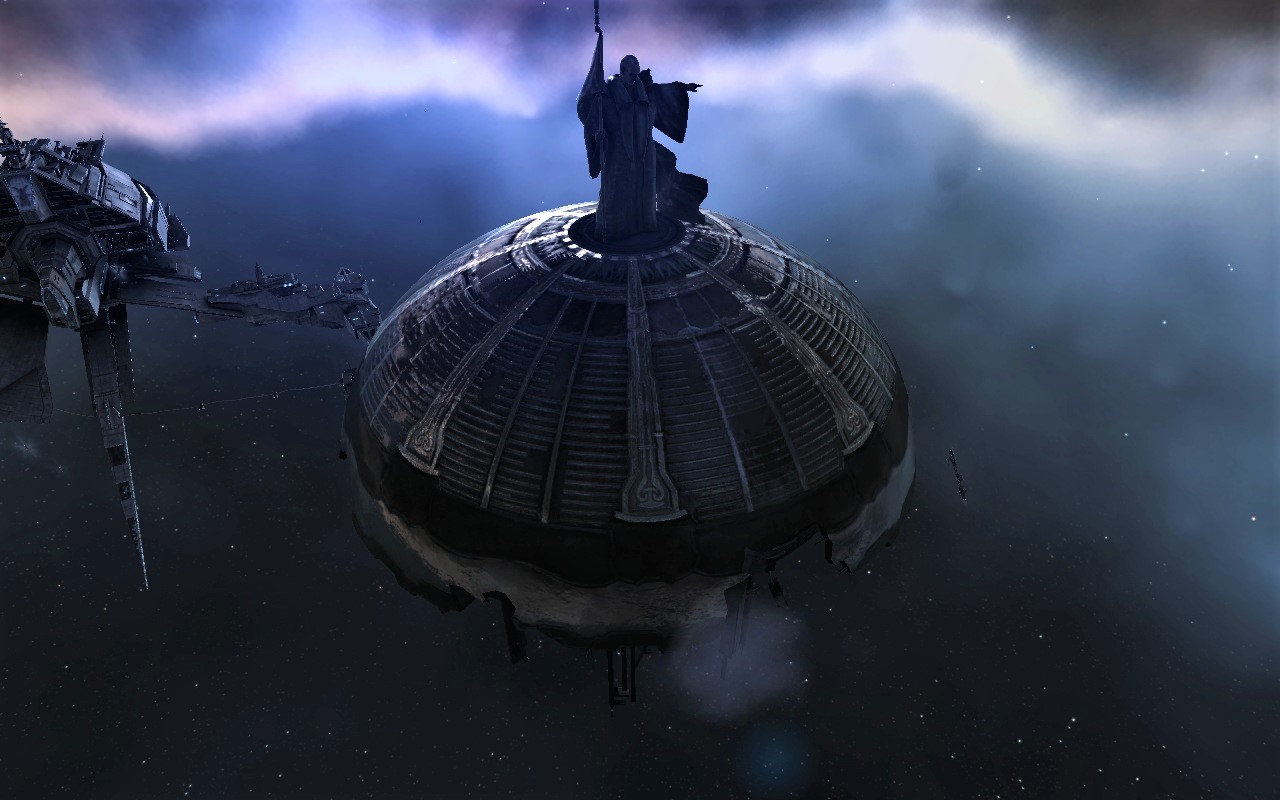
Like the straw that broke the camel's back, the EVE community collapsed into what felt like surface revolt. Within hours pilots began organizing outside the Caldari Navy Assembly Plant in Jita 4-4. Soon after, they got the idea to sphere the famous Jita Memorial statue nigh to better attract tending.
What followed was perhaps the greatest accomplishment in the history of the oldest of online gaming traditions: the unprompted conga line. The protestors' massive conga stretched around the years-old statue like a cracking wheel. The spokes of that wheel were the lasers and missiles they fired at the statue—erected to purity the winners of a riddle contest years early. Though it was an aggressive display, the memorial itself wasn't a destructible object so the simply effect was a sightly cacophony of colours and particle effects lighting up the skies of Jita. The ordinarily uncompromising Jita supercomputer server computer hardware lagged under the strain as thousands of players undocked to join the capital conga line orbiting the nonmoving 3D poser of a robed old man gesturing to the stars.
But players weren't just protesting with their virtual lasers, they were also victimization their cash. Thousands of players deactivated their alternate accounts in a show of protest. While ordinarily a new expansion should lure thousands to a greater extent players, or else onlookers were afraid off from trying Even at each American Samoa this increasingly looked like a virtual humankind happening the brink of collapse. Yet no one could look away, because once more something was happening in EVE Online that nonentity had ever seen before. Protests had happened in more online worlds by now, but never connected this scale, and never with much brilliant screenshots.
"The Council of Stellar Management is beingness flown to Iceland to discuss the issue in an emergency encounter, and I seriously desire that something good comes extinct of information technology," wrote EVE reporter Brendan Drain in an clause on June 26, 2011. "I don't want to retrospect on this weekend in years to come and say to people, 'This was the day that EVE Online died.'"
Stellar Direction
To attempt to quell the contention, CCP called a extraordinary meeting of the histrion-elected Council of Major Management to get word the voices of the players and begin to understand how things had gone so very wrong.
For two days from June 30-July 1, the CSM was in the CCP Reykjavik offices mired in intense negotiations. Previous CSMs served largely at the pleasure of CCP Games, merely this time the council knew it had really leverage to not only impose changes to the stake but as wel to advance the station of the CSM itself and get in a more indispensable institution. The CSM this year was a Who's World Health Organization of nullsec leadership featuring non only The Mittani atomic number 3 its Chairwoman, but also Elise Randolph of Pandemic Legion, Death, Genus Draco Liasa of RAZOR Bond, and Goonswarm diplomatist Evil Grass. At the remainder of the all-night session some parties agreed that the negotiations had been pure and fraught yet fruitful.
Just as protesters continued to swarm the monument in Jita 4-4 CCP Zulu appeared in a cooperative television statement with the Chairman of the CSM (The Mittani) to address the community and hopefully squelch the unrest. Taken over in linguistic context, the resulting TV is one of the much fascinating artifacts of EVE Online's account. Two members of the EVE community—unitary who worked his way upwards through with CCP Games, and other who gained power through with the virtual environment—sit opposed to one another. Miraculously, the cardinal with power derived exclusively from the virtual domain is the one in a dominating position of authority. While The Mittani lounges in his framework chair in front of the camera—spiky gelled blackamoor hair's-breadth, and a chin crowned by a goatee—Zulu sits tensely and leans as far away from The Mittani as possible. Both of them in agreement that the negotiations o'er the past two days had been fraught.
"We were a bit mean," The Mittani says at one point in the video. "I'll go forward and allow that we used alcoholic language. Information technology was actually mayhap a trifle bite wooden when we watched the expressions connected the faces of the CCPers as they read our statement."
The statement signed past the Council of Star Management reads,
"We believe that the situation that has unfolded in the noncurrent week has been a idealized storm of CCP communication failures, poor planning and sheer misfortune. Most of these issues, when dealt with in isolation, were reasonably simple to discuss and resolve, but occluded they transformed a series of errors into the most significant crisis the EVE community of interests has so far experienced. We desire that this get together will be the first step in the restoration of trust between CCP and the Eventide community of interests, and we will keep the community informed arsenic to CCP's efforts in delivering on the commitments they rich person made to us and to you."
It was a humble end to a geological period that witnessed a player revolt that price CCP roughly 8% of its subscriber base.
A testy truce was agreed to in Iceland with some parties publicly agreeing that CCP had no plans to revilement pay-to-win business models. However, the meeting and the Jita Riots had exposed a colourful vulnerability in the EVE Online business modeling. What happens if the players within the virtual community set out to devise? Is CCP really in charge if the players are voluntary to cancel their subscriptions en masse? In early online games the slang for "developers" was literally "gods" because they at last controlled the off-switch for the gamy and could interchange it in whatsoever way they proverb tantrum. The Jita Riots had raised a attractive motion: who was in control of the slay-tack of Evening Online? The past online game devs would often shut down their virtual worlds after sentence had passed, matter to had waned, or the workload became as well great. CCP Games no more had the choice of close gone. Information technology had improved a company of 600 employees off the success of EVE, and now multiple other gamy production teams were being supported by its success. It's not melodramatic to say that the sudden failure of EVE could have had notable consequences for the nation of Iceland. CCP now had investors and employees with children to consider. No person or group of populate at CCP was susceptible of making the choice to shut down the game.
The players, however, had shown that they ultimately could, or at least that they could briefly put it into viscus nail. Player protests of this sort could affect salary, and even a hiccup in payments could drastically cut off operations at CCP.
EVE Online itself had encouraged the players to form these untidy organizations, and like a sho those very organizations were the grassroots of a movement that had spread crossways the mavin bundle and had miraculously proved that the EVE community was somehow more in master of Evening than CCP Games itself. If the game died, it seemed, IT wouldn't be a result of developer intervention. It would be because the players walked away.
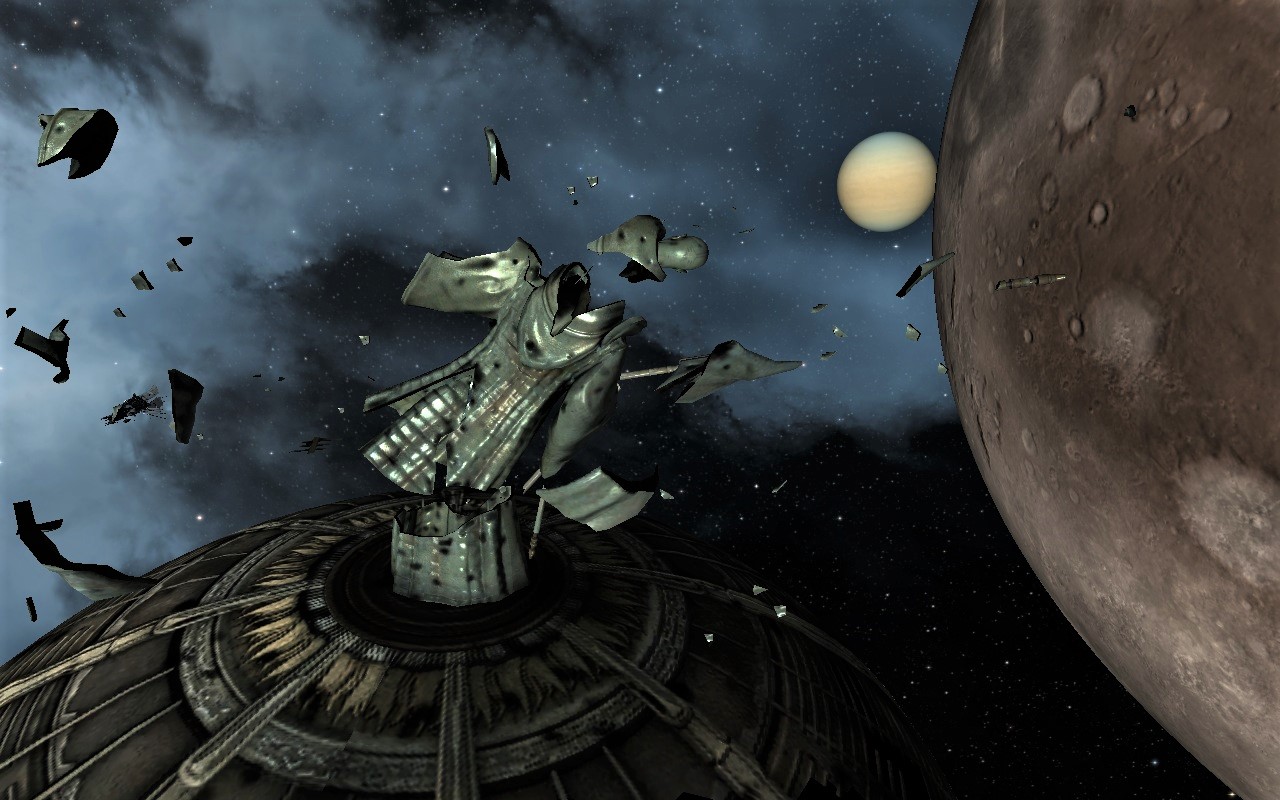
"October 5 scarred the authorized last of the Summer of Rage with two devblogs," wrote Matterall—an EVE journalist and podcast host of "Talking In Stations"—in a ex post facto. "The first was from CCP Zulu who communicated an 'immediate refocusing of all the EVE development teams connected EVE's core gameplay: spaceships.' EVE Online's Winter 2011 expansion, which would ejaculate to exist titled Crucible, would include a washing list of improvements and fixes. The second was from CCP CEO Hilmar Veigar Pétursson who issued his own apology letter admitting, 'I was wrong, and I admit it.' It was a humble end to a period that witnessed a player revolt that be CCP roughly 8% of its subscriber immoral. However, IT was also the beginning of a new era when CCP would become better communicators, more engaged with the players, and more focussed along fixation the issues that had heaped up for adieu."
CCP Games was left in Iceland with a late reality to manage with. The temperature in the biotic community was finally beginning to normalize and the protests were dispersing. Still, the number of subscriptions to EVE Online was down 8%. This after hoping that Incarna would usher in a new era of CCP Games in which EVE Online would finally become "the rarefied dame of play."
Instead, the community realized its position of exponent, and CCP Games was forced to face an internal reckoning. With subscriptions declining for the first time in almost ten years and progress slowing happening both DUST 514 and Globe of Darkness, CCP Games announced a 20% stave cut. One in basketball team of CCP Games' 600 employees was to be laid off immediately.
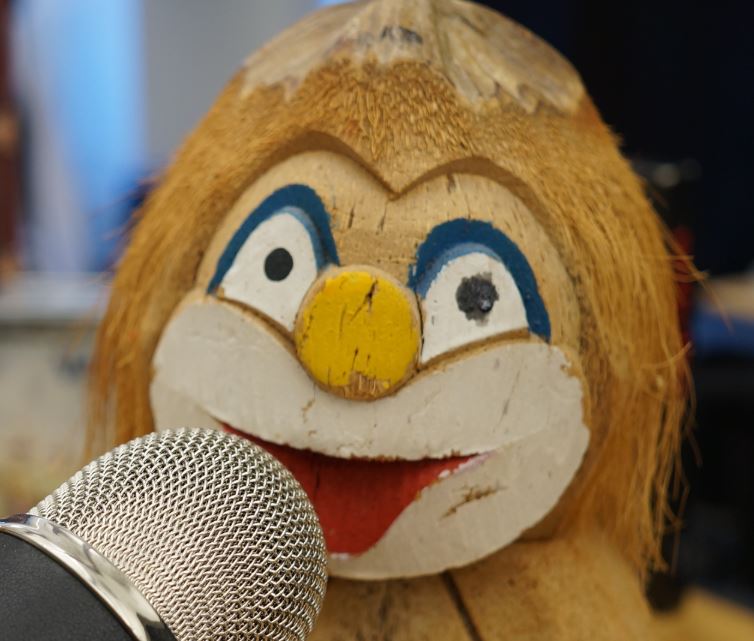
Hey folks, beloved mascot Coconut Monkey Here representing the collective Personal computer Gamer editorial team, World Health Organization worked together to write this article!

Source: https://www.pcgamer.com/eve-online-empires-of-eve-volume-2-excerpt/
Posted by: mayfielddisce1964.blogspot.com
0 Response to "How greedy microtransactions sparked EVE Online's disastrous Summer of Rage | PC Gamer - mayfielddisce1964"
Post a Comment