

Can A Retinal Tear Repair Itself
Retinal Tears
Symptoms
A patient with an astute retinal tear may experience the sudden onset of black spots or "floaters" in the affected eye. This can have the appearance of someone shaking pepper in your vision. Flashes of light (Photopsia) are another common symptom.
If there is associated vitreous hemorrhage (haemorrhage in the clear cavity of the middle) or retinal disengagement, additional symptoms can include blurred vision or a shadow equally if curtains are endmost in from the peripheral (side) vision. However, in some cases, a retinal tear may not manifest whatsoever noticeable symptoms.
Causes
The vitreous is a clear gel-like substance that fills in the back crenel of the eye which is lined by the retina. At birth, this gel is attached to the retina, merely as we age, the gel separates from the retina creating a posterior vitreous detachment or PVD. In near cases, this happens without whatsoever issue.
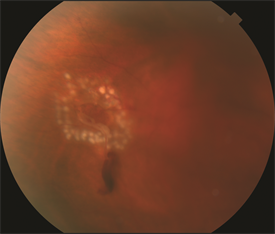
Figure ane. Light amplification by stimulated emission of radiation photocoagulation around retinal tear with small hemorrhage. Photo courtesy of Larry Halperin, MD
However, in people who take an inherently more "glutinous" vitreous, as the vitreous separates from the retina, it pulls abnormally (abnormal vitreo-retinal adhesion) and causes the retina to tear. Although retinal tears may also occur equally a result of center trauma, almost retinal tears occur spontaneously due to a PVD.
A related entity are retinal holes. The term retinal tears and holes may be used interchangeably by some retina specialists. Retinal tears develop when the vitreous pulls on the retina while retinal holes develop due to progressive thinning of the retina. Retinal holes are typically smaller and accept a lower adventure for causing a retinal disengagement. There are some instances where retinal holes should be treated the same as retinal tears.
Risk factors
Risk factors are non required to develop a retinal tear, but they make the likelihood greater. These factors include:
- Avant-garde age
- Caste of myopia (nearsightedness)
- Associated lattice degeneration (thin patches in the retina)
- Trauma
- Family history of retinal tears or disengagement
- Prior eye surgery
There is no fashion to predict who might develop a retinal tear or when it might occur.
Diagnostic testing
A thorough and timely exam past a retina specialist using scleral depression (applying slight pressure to the eye) and/or a 3-mirror lens is the well-nigh important step in diagnosing a retinal tear. In cases where in that location is a limited view of the retina due to overlying hemorrhage, ophthalmic ultrasound may exist required to aid in diagnosing a retinal tear.
Treatment and prognosis
If a retinal tear is diagnosed promptly before it progresses to retinal detachment, the prognosis is extremely skilful. Retinal tears are typically treated with laser or a freezing procedure (cryotherapy). Treatment is performed in an function setting and is very effective and quite safe.
Topical or local anesthesia is utilized, and the procedure is simply mildly uncomfortable. The handling creates spot-welding around the edges of the tear that nearly eliminates the risk of the tear progressing to retinal detachment. After a tear has been treated, there remains a future risk of developing additional, split retinal tears; therefore, continued monitoring is important.
Non all retinal tears require treatment. When low-risk tears are identified in patients who have no symptoms, these tears tin be observed without handling. Some tears "treat themselves," meaning they develop adhesion around the tear without treatment, and these situations tin be followed without treatment equally well.

Source: https://www.asrs.org/patients/retinal-diseases/26/retinal-tears
Posted by: mayfielddisce1964.blogspot.com
0 Response to "Can A Retinal Tear Repair Itself"
Post a Comment